
Higher Education’s Final Exam
Will higher education survive its most existential threat to date?

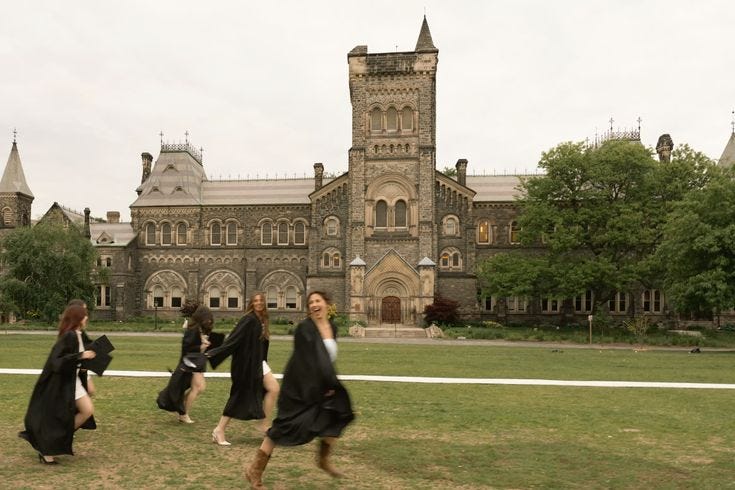
I’ve spent the past year obsessing over anything and everything to do with careers: the future of work, what makes work meaningful, the death of the corporate job. In all that time I’ve written very little about what AI is likely to do to education, and the main reason is that I find it hard to predict. We’re talking about institutions that have been around for centuries, that have very specific ways of doing things, and that are incentivised, by funding rules and league tables, to chase outcomes most of us would question. But I want to open the conversation, because education is a large part of what we’re building with Rumbo, and it sits upstream of everything else I write about. Every lost 27-year-old I speak to was once a 17-year-old making enormous decisions inside this system.
You may have heard the history before, some of it from me. Education as we know it was built in the industrial era to produce standardised workers for standardised jobs, and it has barely changed while the economy around it was rebuilt several times over. I don’t need to reiterate any of it here; if you want the full story, I wrote about it last November. The question this time is what happens when you drop the most disruptive technology we’ve seen since the internet, and perhaps ever, into a system already wildly out of date.
Three years in, the students have already given their answer. This year’s HEPI survey found that 94% of UK undergraduates use generative AI to help with assessed work. Adoption at that scale, at that speed, is close to unprecedented for any technology, and it happened among people paying £9,535 a year for access to the very thing being automated.
It only looks like a generation setting fire to its own money if you believe university is about access to knowledge. It stopped being that a long time ago. A third of UK graduates work in fields unrelated to their degree subject, and around four in ten sit in jobs that require no degree at all; with numbers like those, it’s painfully clear what the degree really offers: a buffer between childhood and adulthood, a purgatory for people who aren’t yet ready for the weight of the real world, financed by a debt mechanism few of its participants could accurately explain. Three years of AI have simply pulled the tide out and left the whole arrangement sitting exposed on the sand.
Despite never once having to measure the acoustic dynamics of a room since graduating (I studied music production), I got a lot out of university. What’s endured is everything that happened around the degree: being put in a flat with strangers during COVID and having to learn to get along with them, and finding my feet in a city where I knew nobody. All of it was worth having. But let’s call a spade a spade: it was a very, very expensive experiment in adulthood.

The economist Bryan Caplan reached a similar conclusion through the data. In The Case Against Education, published back in 2018, he argued that schooling is mostly signalling: students sit through years of material they’ll never use because the certificate at the end tells employers they’re intelligent, conscientious and willing to conform. He pointed to what economists call the sheepskin effect, where the final year of a degree, the one with the certificate attached, raises your earnings far more than any of the years of learning that came before it. His thought experiment was blunter still: offered a Princeton education with no diploma or a Princeton diploma with no education, nearly everyone takes the diploma. Read the HEPI number through Caplan’s eyes and the puzzle dissolves. Using AI to skip the learning is only strange if you’re there to learn. If you’re there for the certificate, it’s like paying for a gym membership and sending a machine in to lift the weights, except the membership card is the thing your future employer checks.
Even in a system built around certificates, the learning was real for anyone who did it. What we’ve misjudged, for generations, is where its value sits. We talk about education as the acquisition of knowledge, as though the point were the stock of facts a graduate carries out the door, and on that view AI writing your essays is a harmless shortcut to the same destination. The lasting value was always in the process of learning and everything wrapped around it. An essay does its work on the writer: the weeks of holding an argument in your head, noticing the gaps in your own reasoning, rewriting the paragraph that turned out to be wrong. All of that work is invisible in the finished document. A group at MIT’s Media Lab ran a study last year that made it visible. They wired students up to EEG caps and had them write essays, some with ChatGPT, some with a search engine, some with nothing but their own heads. The ChatGPT group showed the weakest brain connectivity of the three, reported the lowest sense of ownership over their writing, and most of them struggled to quote a single line from essays they had finished minutes earlier. The researchers called the pattern cognitive debt: the essays themselves were fine, and the people who produced them were untouched by producing them.
The institutional response has split. Some universities are carrying on as if the technology can be waited out, with bans, detection software and a retreat to handwritten papers; in the HEPI survey, barely a third of students at any type of institution feel encouraged to use AI, and some describe assessments deliberately hardened as a countermeasure. Others are trying to innovate and discovering that degree standards, quality assurance and the wider regulatory system were never designed to move at this speed. I have more sympathy for the second group, because banning AI and pretending it will play no part in students’ professional lives is unrealistic and unfair. Graduates who’ve been trained on these tools will be playing a different game entirely from those who haven’t, and it’s the students inside that first group of institutions who will pay for the pretence.
The detection software is its own scandal. Stanford researchers tested seven widely used AI detectors and found they falsely flagged 61% of essays by non-native English speakers as machine-written, while judging native speakers’ work almost perfectly. Innocent students are being marched into misconduct hearings by tools that mistake a second language for a chatbot. And underneath the whole defensive posture sits a bitter joke: the technology being banned is the most serious candidate education has ever had for its oldest problem. In 1984 the educational psychologist Benjamin Bloom showed that one-to-one tutoring lifted average students to the top of a conventional class, an effect so large he named a challenge after it, the two sigma problem: find something as effective as a personal tutor at a price schools can afford. Nobody has yet shown that AI matches a good human tutor, and it may never, but for the first time in forty years there is a candidate at roughly twenty dollars a month, and the sector’s first instinct was to prohibit it.
Employers, meanwhile, have stopped waiting for the sector to work this out. Harvard Business School researchers have been tracking what they call the degree reset, a steady stripping of degree requirements out of job adverts that began before ChatGPT and has accelerated since. UK employers received a median of 140 applications for every graduate vacancy last year, up from 38 twenty years ago, with AI increasingly writing the applications and AI increasingly screening them, so the biggest firms now run their own assessments, work trials and structured interviews. That is what you build once a certificate stops carrying information. To be fair to the degree, it still mostly works, and 88% of UK graduates are in work or further study within fifteen months. This is an erosion, and erosions take time. But every employer that builds its own filter is casting a vote on how much the certificate still tells them.
There is a version of this where universities come out stronger. For centuries they marketed themselves as keyholders, the institutions that controlled access to important knowledge, and AI has broken that gate off its hinges. What they could become is the place you go to learn what to do with knowledge: curated experiences where students take what AI can generate and organise, then apply it to real problems in front of real people, learning to construct an argument and defend it out loud, to speak publicly and survive being questioned, and to judge which parts of the torrent of information coming at them deserve attention at all. Young people are about to be hit with more information than any generation in history, and they will need practical guides for what to do with it all far more than they need another gatekeeper.
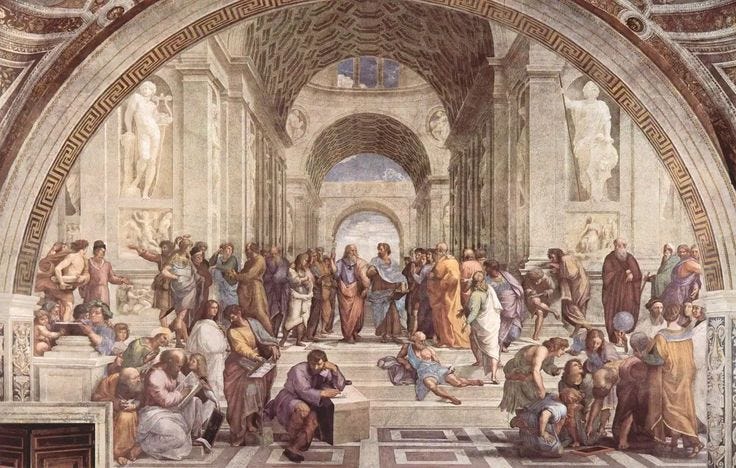
My prediction is that assessment follows the same path and moves back into the room, towards the oldest form of the thing: the viva, the tutorial, the argument defended in front of people who can push back. Some professors are already proposing exactly this, and because teaching this way is labour-intensive by design, it carries a conclusion few people see coming: AI creating demand for more teachers. Not everyone thrives in that format, though. People think differently under pressure, and a return to high-stakes performance grading would suit some students as badly as the exam hall always has. A curriculum built around regular debate and discussion is a gentler and better thing than a single terrifying viva. But thinking quickly and critically out loud, under questioning, is a skill the world will keep asking for, and an oral tradition is impossible to outsource.
A few weeks ago I posted a short note arguing that power has shifted from knowledge to judgement. Knowledge is now abundant, close to free, and available to everyone with a phone, and judgement, the ability to tell good from bad, signal from noise, when to trust the machine and when to overrule it, has become the scarce thing. What I couldn’t answer in that note is where anyone is supposed to go to develop it.
The prediction I’d stake most on is the one that sounds most old-fashioned. Take away knowledge transmission, which AI now does better and for free, and take away the certificate, which employers trust a little less each year, and what’s left is the oldest purpose of the whole enterprise: building the person. I mean self-understanding and judgement, the ability to hold your ground in a room of people who know more than you do, to tell good work from bad without asking a machine, to explain what you want and why. No school I know of teaches any of this deliberately. The classical world aimed its entire education at it and treated knowledge as raw material for the person being built, and whether that education made better people is impossible to prove, but it was at least pointed at the right target.
If that lands anywhere near true, it would be the best thing AI does for education, and maybe for any of our institutions: forcing them to remember what they were for.
Alex,
I sincerely believe that you have hit the nail on the head. Having spent more than fifteen years in higher education both teaching and as an administrator, I share your concern. So much of the institution is built on intelligence. As AI commoditizes intelligence, the differentiator will be the wisdom with which it is applied.
Earlier today, I finished answering a set of questions from a journalist who is writing an article on the impact of AI in schools using the case method of teaching. I share your perspective that "banning" AI is unfair to the student; they will be entering a workplace where AI is proliferating. The question for the instructor, whether or not approaching education with the case method, is how can you leverage the student's use of AI to strengthen the development of their wisdom: discernment, judgment, decision-making amidst uncertainty, values and ethics, etc.
All too often, wisdom grew out of learned experience on the job. It was the early employee's supervisor and peers who guided them through that period. What a gift to both the student and the employer to start that process in their higher education experience (or earlier?).
Yes, AI can "dumb down" the student, and the worker, if we let it. But it also can support them reaching worlds they had never dreamed possible before. In higher education, it is up to the faculty. In the workplace, it is up to the leaders.