
How to Not Know.
A conversation with Simone Stolzoff on the power of uncertainty in a world that demands answers.


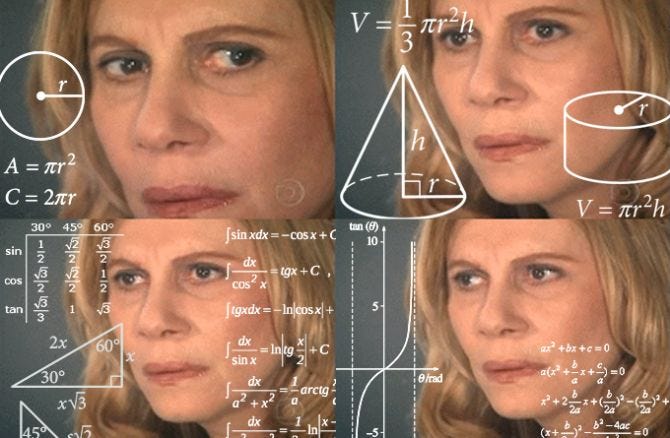
About a year ago, towards the end of seven months travelling around Latin America, a close friend recommended I read The Good Enough Job by Simone Stolzoff. I was in Mexico at the time, the last stop on a trip during which I’d worked out, slowly and with some reluctance, that I was bored of working in marketing and wanted to spend the next phase of my career on helping people find meaningful work. I knew this was the problem space I wanted to work in, but I knew very little else. I hadn’t yet done the work of forming my own ideas about what was really going wrong, what I thought a real solution might look like, or what my particular angle on the problem might be, and I was at that uncomfortable stage where you’ve made a big decision in principle and still have everything to figure out in practice.
Simone’s first book was one of a handful of inputs that arrived in roughly the same fortnight and helped me start to put a frame around what I was thinking. I was finishing up a stretch of work with a careers coach, which had forced me into the kind of self-examination most people in conventional jobs never get the prompt to do. I’d just read Rutger Bregman ’s Moral Ambition, which set out a coherent theory for something I’d been observing in my own peer group for months, about how much of the talent of our generation is being absorbed by industries that don’t really need it and don’t really matter. I was also having long, often quite raw conversations with friends and peers who were stuck in jobs they didn’t believe in and didn’t know how to get out of. And then The Good Enough Job showed up, which is a philosophical book that questions whether the convention of tying our professions so tightly to our identities, the way our culture currently does, is a sensible arrangement for either us or our work, or whether it’s something we’ve drifted into that we should now try to drift back out of.
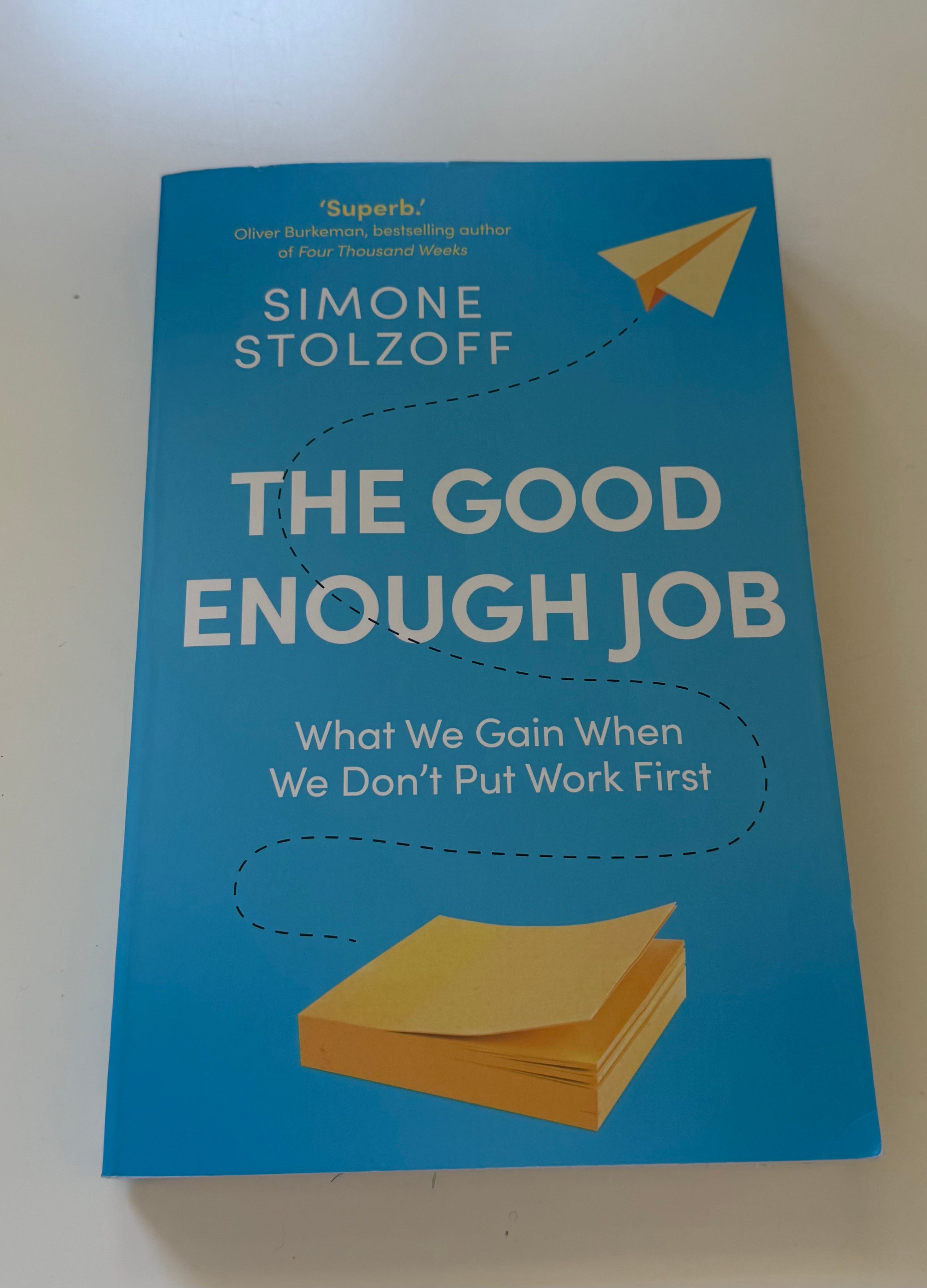
His new book, How to Not Know, is the natural next step. The first book was diagnostic, full of real stories of people who’d over-invested their identities in their jobs and were paying for it. The new one is more practical, written for people who agree with the diagnosis and need help working out what to do about it, particularly given how much of what surrounds work is currently in flux. Last week I had the chance to speak with Simone about the writing of it, how his thinking has shifted between the two books, and how his own relationship to work has developed in the meantime.
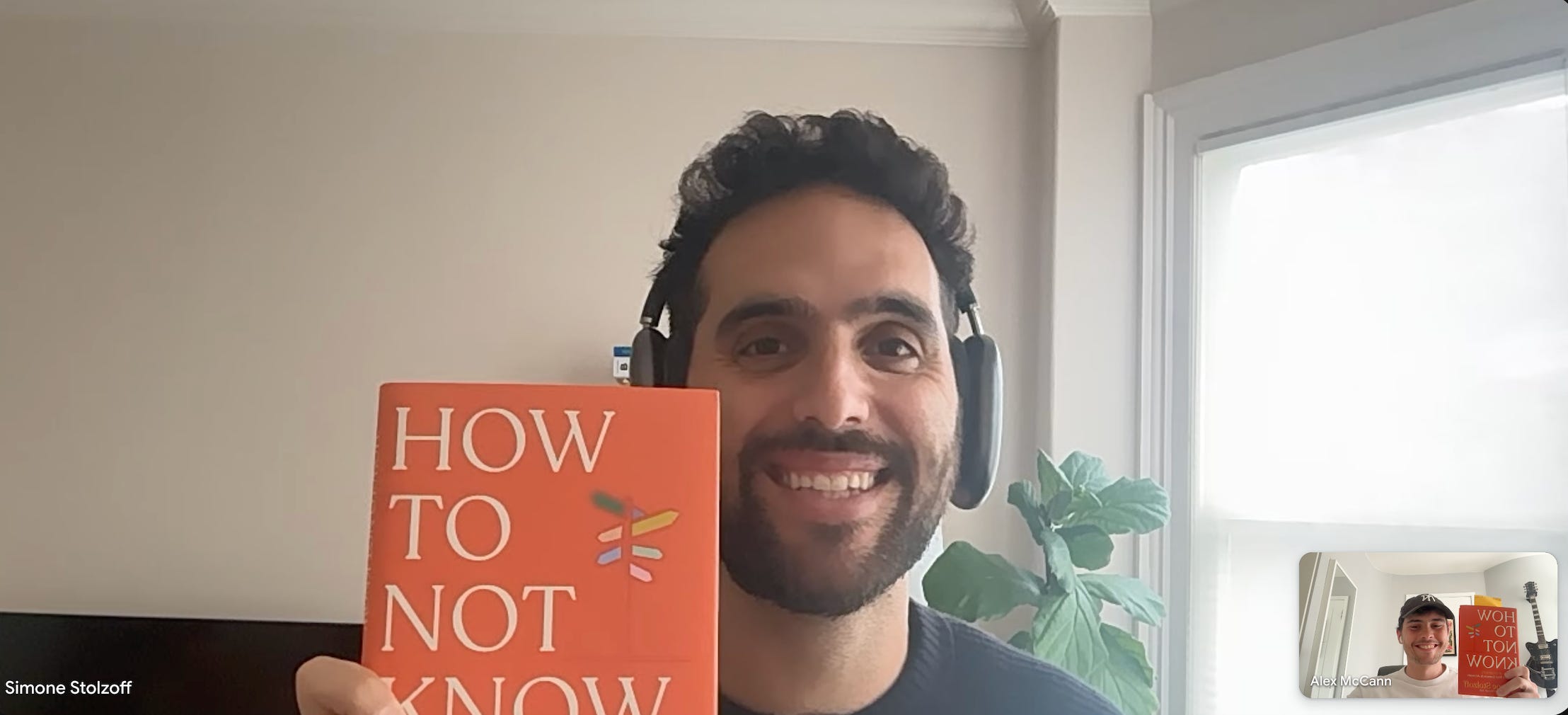
A version of my favourite question to ask successful people I’m lucky enough to interview is whether the kind of advice that runs through a book like How to Not Know is really available to the people who most need it. People who write books about following your curiosity and trusting the path tend to be people for whom following their curiosity has worked out spectacularly. They’ve climbed a first mountain and earned the credibility that lets them then preach the value of the meander. So when they tell a 23-year-old who’s drowning in rent and graduate-scheme rejection emails to relax their grip on certainty, there’s something a bit galling about it, even when the underlying argument is right.
Simone agreed there’s a survivorship bias running through the whole genre, particularly in the people who tell you to follow your passion, who happen to be the ones for whom following their passion paid out. He then offered a more nuanced view of his own position. He’s not unambiguously on the winning side of the trade he made. He optimised for curiosity over income and now lives in San Francisco with his wife and a young son, and a lot of his closest university friends who took the conventional consulting and finance routes are now VPs making roughly five times what he does. What he is rich in, he said, is alignment between how he spends his time and how he wants to spend it, which doesn’t show up on a payslip but starts to look more valuable the longer you hold it. And one of the underrated benefits of the meandering path, he added, is that he now has the evidence that he can figure out who he is again if he ever has to start over.
The version of the answer he gives in the book, and the part that connects most closely to what we’re trying to build at Rumbo, is that the way through uncertainty is action. He talks about being a leader, or really anyone trying to do something without a map, as being like rowing a boat across a lake on a foggy day. You can’t see far in front of you, you don’t know exactly where you’ll come ashore, but you have two jobs. Keep faith that you’ll reach land eventually, because you’re in a lake and you will. And in the meantime, keep rowing, because it’s only through the rowing, through the doing, that the fog starts to thin. The point is that clarity tends to come on the other side of action, in the form of what you’ve learned by trying.
This is the part of his thinking I most agree with, and it’s also broadly how Rumbo has come together. We started with a hypothesis about how people get stuck in their careers and what kind of platform might help them get unstuck, and the way we’ve found something close to product-problem fit over the last six weeks is by running an enormous number of small experiments, watching what people do, and updating. The product I’m shipping six weeks after launch is meaningfully different from the one I had in my head a year ago, and the differences are almost entirely things I couldn’t have known before I started building. There’s a contemplative element to it, but the core of it is action. It’s a willingness to keep moving under conditions of not-knowing, where each shipped version reveals the next set of questions you didn’t realise you needed to ask.
I asked Simone about the question almost everyone reading this will recognise. The world doesn’t change just because you’ve decided to be more comfortable with uncertainty. People are still going to ask you, at parties and family dinners and on first dates, what you do, and if your honest answer is some version of “I’m figuring it out” or “I’m between things,” that question can bring up a lot, particularly when you can see the asker losing interest in real time. His most useful suggestion was to change the question itself. The default, “what do you do,” collapses a person into a job title and treats that title as a stand-in for who they are. He prefers, and tries to model in his own conversations, “what do you like to do,” which makes room for the parts of someone’s life they care about most and rarely get to talk about at a drinks reception. He told me about a lunch with Simon Sinek where, when asked the standard question, Sinek said something close to: I want to help leaders become the best versions of themselves, and I do that by writing books and giving talks. The job description came second, and the reason for doing it came first, which is a small reordering that does a surprising amount of work.
He also said being honest about where you are is one of the fastest ways to find the people who can help you, and one of the most reliable ways to filter out the people who can’t. I agree. I spent a lot of time at networking events in my early twenties as the youngest person in the room, and when I told people I was figuring things out, or between things, I could see their eyes scanning for someone more useful. At the time it stung. Looking back, those people sorted themselves out of my life without me having to do anything, and the mentors and friends who’ve stuck with me are the ones who, when I told them I was in between, ignored that part and said tell me what you’re interested in, and meant it. The first question, in that sense, does the work of a filter for you.
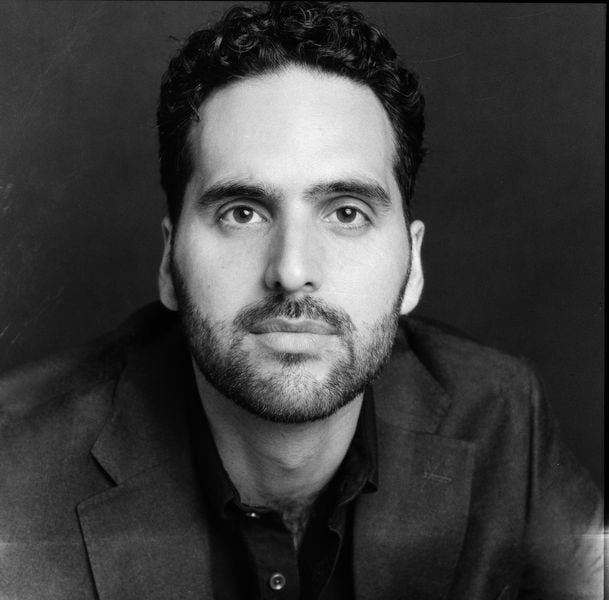
A line Simone uses in the book, which he picked up from the poet Anis Mojgani, is that some people do what they love for work, and others do work so they can do what they love when they’re not working, and that neither is more noble than the other. As someone whose business and career feel more bound up with my identity now than at any other point in my life, I’ve found that line useful in a specific way. It’s made me less judgemental of, and more empathetic towards, the people I know who’ve consciously chosen to put their identity somewhere else. The friends who treat their job as the thing they do to fund the parts of life they care most about. The ones who’ve structured their week around their family, or a sport, or a craft, or a religious practice, where their professional life is the supporting infrastructure and the meaning sits elsewhere. It’s easy, when you’re as deep in something as I am, to assume the rest of the world should organise themselves the same way you do. The line is a useful thing to have around when you catch yourself thinking that.
If you’re feeling uncertain in your career and it’s weighing on you, I’d highly recommend How to Not Know. It’s a book about agency under uncertainty, which is the underlying condition of almost every career and almost every business worth working on.
 | A guest post by
|
Thanks so much for featuring my work, Alex! Hope y’all check out the book: https://www.amazon.com/How-Not-Know-Uncertainty-Demands/dp/1324089458
When you’ve always been the career person it’s hard to suddenly not be. Whether that be by choice or the decision has been forced upon you, it’s hard for people to understand from the outside. Great read, will check out the book. Thank you!